
We counted every answer. Here's how Bacaform did.
Any tool that reads handwriting will make mistakes. The real questions are how many, which ones, and whether you'll ever know. So we put Bacaform through a proper test, counted every single answer, and wrote down the results, good and bad.
The test in one picture
- 108 pages
- 1,132 answers
- read 3 times
How we tested it
No cherry-picking, no single "best" form. We keep a fixed set of filled-in paper forms just for testing: a bus service survey, a course evaluation, a gallery visitor card, a community poll, a workshop checklist and ten more. Some answers are circled, some ticked, some crossed, some written in a box, some scribbled across a line. Every form is both scanned on an office scanner and photographed with a phone, because that's how real piles arrive.
During development, we ran the whole set through Bacaform, live, exactly as a customer would, and checked every answer against what was actually written. Then we did it twice more.
The headline: 97.5 out of every 100 answers, right first time
Of the 1,132 answers on those pages, Bacaform read 97.5 % correctly on its own, before any person looked at anything.
That number on its own doesn't tell you much, so here's what it looks like on an ordinary form.
A 20-question form
- 17 go straight in
- 3 flagged for a quick look
Take a 20-question survey. Bacaform reads all 20 answers. On average it gets one answer wrong in every two forms, and here's the important part: it usually knows when it isn't sure.
Every 100 answers
- 84 Accepted without a look
- 16 Shown to you for a quick check
Of the 84, only about 1 in 570 is wrong.
The number that really matters: mistakes you never hear about
Every reader makes mistakes, people included. What hurts is the mistake nobody notices, the one that quietly sits in your spreadsheet and turns up in your report.
So Bacaform doesn't just read. Whenever an answer looks doubtful, a smudged 4 that could be a 9, two circles where there should be one, a word half off the line, it puts up a flag and sets that answer aside for a person, right next to a picture of the actual mark.
In our test, about 94 of every 100 mistakes were caught this way, flagged before they reached the spreadsheet. What slipped through unflagged came to just 0.15 % of all answers, about 1 answer in every 670.
Of every 100 mistakes
- 94 Flagged for you
- 6 Slipped through
A pile of 100 forms
- 100 forms × 20 questions = 2,000 answers
- about 320 flagged for a quick look
- about 3 mistakes slip through
How does that compare with doing it by hand? Industry write-ups commonly put the error rate of manual data entry at about 1 % [source 2], and a mistake made during data entry comes with no flag at all. That's about 20 silent mistakes in the same pile of 100 forms, against Bacaform's 3.
Mistakes that end up in your spreadsheet, per 100 forms of 20 questions
What it reads best
Not every kind of answer is equally easy. Here is how each kind did in the test.
Read right first time, by kind of answer
- Numbers written by hand: every one right. Ages, hours, scores, quantities.
- Comments and written words: every one right, and not one handwritten answer was read wrongly with high confidence.
- Circled and ticked choices: 96.9 % right on their own, and not one wrong choice slipped through without a flag.
- Dates: 96.8 % right. Two years on phone photos were misread (2016 for 2026), which is why dates are worth a glance.
And the messy stuff people actually do on paper:
- Two answers circled on one question: spotted and flagged 10 times out of 10.
- An answer scribbled out and another marked instead: flagged 89 times out of 90, and none slipped through.
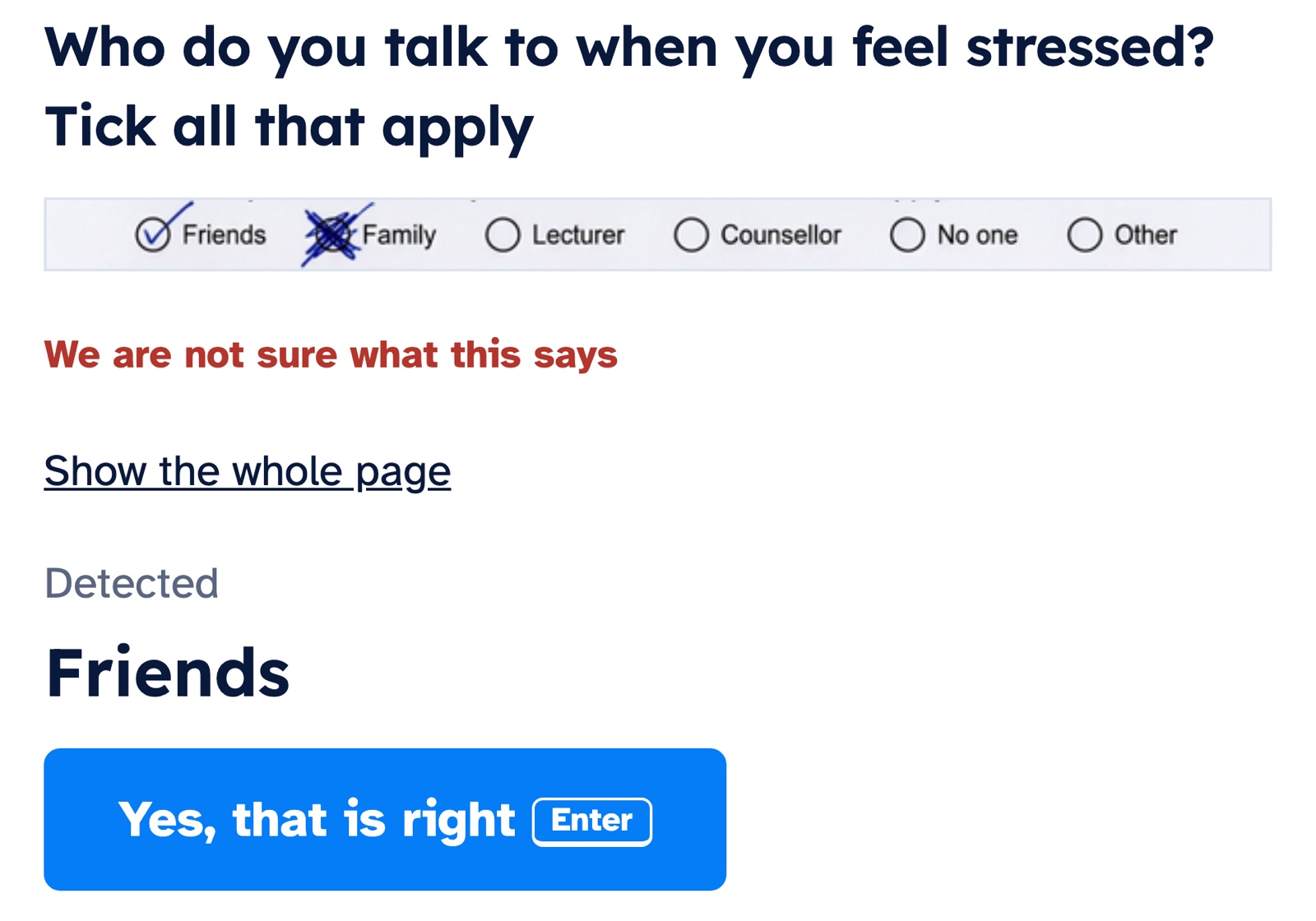
Setting up a new form
Before Bacaform reads a pile, you show it two or three filled-in copies of your form. It works out the questions, where each answer sits, and what kind of answer belongs there. You look it over once, fix anything it missed, and you're ready.
We tested that too, on all 15 forms.
Questions found at set-up
- From scans, Bacaform found 99.6 % of the questions by itself. On a 30-question form, that's typically all 30.
- From phone photos, it found 93.3 %. On a 30-question form, about 28; you add the other 2 while you look it over.
- The boxes fit. Each answer box it draws sits almost exactly on the printed answer: for half the answer boxes in our test, 99 % or more of the printed answer area fell inside the box.
Our tip, straight from the numbers: if you have a scanner, set up from scans. Then photograph or scan the pile however suits you; Bacaform reads both.
What this means for your week
Here's where accuracy turns into time.
Data entry for a 25-question form takes about 3 minutes by hand, by one published estimate [source 1]. That sounds small until there's a pile.
Your time for a pile of 100 forms
- By hand: 100 forms is about 5 hours of data entry. 400 forms is about 20 hours, two and a half working days.
- With Bacaform: the reading happens without you, at about 11 seconds a page with many pages read side by side. Your part is the flagged answers: about 3 per 20-question form, each one shown next to the mark, so most take a glance. If each takes ten seconds, the checks for 100 forms come to under an hour.
- And fewer mistakes at the end: about 3 silent errors in 100 forms, against about 20 by hand.
That's the difference between a survey you put off for weeks and one that's in a spreadsheet the same evening. The student finishes the chapter. The trainer sends the feedback report on Monday. The clinic sees this month's scores this month.
The honest small print
- These figures come from our own test set of 15 forms, run during development. Your forms, your handwriting and your photos will differ, so the numbers will too. That's why every doubtful answer comes to a person, and why every page stays beside its row so you can check any answer later.
- One more detail, for the careful reader: our test checklist had "N/A" answers that our test script itself can't record. We left those out of the 0.15 %. Counting them anyway, the share would be 0.91 %, still better than the 1 % commonly quoted for data entry by hand.
- We'll run the same test again whenever we change how Bacaform reads, and update this page.
Try it on your own pile
A new account gets 20 free pages and 10 free set-up pages: enough to set up one of your own forms and see your own answers come back as rows. After that, page packs start at RM 10.
Sources
- ImageToTable.ai, "The Real Cost of Manual Form Data Entry", 2026: a 25-question form at three minutes per form. https://imagetotable.ai/blog/manual-form-data-entry-cost
- Heikki Laurila, "Manual Data Entry Errors", Beamex blog, 2021: "the typical error rate in manual data entry is about 1 %". https://blog.beamex.com/manual-data-entry-errors